Inside a Modern DSP: Six Capabilities Performance Marketers Should Look For#
Programmatic advertising has matured significantly over the last decade. What was once primarily a way to buy digital impressions at scale has evolved into a sophisticated ecosystem built around audience intelligence, automation, creative personalization, and measurable business outcomes.
Today, the question isn't whether a DSP can access inventory. Most can. The real differentiator is how effectively a platform helps marketers plan campaigns, reach the right audiences, optimize performance, and connect advertising efforts to meaningful results.
For brands and agencies evaluating programmatic solutions, there are six core capabilities that separate modern DSPs from platforms that simply facilitate media buying. Below is a vendor-neutral breakdown of those capabilities — and, where it's useful, a note on how each one is implemented inside the Manifold campaign workflow.
Key Takeaways#
- Strong DSPs are measured by outcomes, not just CPMs or auction wins.
- Effective campaign planning starts with understanding audience reach, overlap, and inventory quality before budgets are deployed.
- Modern targeting strategies combine syndicated audiences, first-party data, and predictive modeling.
- Creative quality remains one of the largest drivers of campaign performance.
- Direct publisher relationships and curated inventory pathways help improve transparency and efficiency.
- Identity-based measurement is becoming essential for understanding the true impact of advertising across channels.
1. Planning Starts with the Audience#
Successful campaigns begin long before the first impression is served.
While media planning once focused heavily on placements and pricing, today's marketers need a much clearer understanding of audience behavior before allocating budget. Questions such as where audiences spend time, how channels overlap, and what incremental reach can be achieved across platforms are becoming increasingly important.
Modern DSPs should help answer these questions through tools that provide visibility into audience reach, inventory availability, and campaign forecasting.
Some capabilities worth evaluating include:
- Cross-screen reach forecasting that estimates audience overlap between channels such as linear TV, Connected TV, mobile, desktop, audio, and digital out-of-home.
- Supply path transparency that shows how inventory is sourced and which intermediaries are involved in the transaction.
- Audience intelligence tools that provide demographic, behavioral, geographic, and lifestyle insights based on authenticated user data.
Platforms connected to large logged-in ecosystems often have an advantage because they can provide deeper audience visibility and stronger identity resolution than platforms relying solely on inferred signals.
Inside Manifold. Planning is built into the wizard before any spend decision. As users compose an audience in Step 2, an Audience Scope Indicator scores the in-progress audience in real time and flags whether the build leans too narrow or too broad. In Step 3, a Total Addressable Market view models reach against the selected geos and segments and produces an Estimated Reach range tied to the campaign's budget. Both of these run continuously as the audience is edited — so by the time a campaign goes to review, the team has already seen the math.
2. Audience Targeting Requires More Than Segments#
Audience targeting has become increasingly sophisticated, but most successful strategies still fall into three primary categories.
| Audience Type | Description | Best Used For |
|---|---|---|
| Standard Audiences | Pre-built demographic, behavioral, lifestyle, and in-market segments | Prospecting, awareness campaigns, and broad audience reach |
| Custom Audiences | CRM-based audiences, customer lists, retargeting pools, and modeled look-alikes | Retargeting, suppression, customer expansion, and loyalty initiatives |
| Predictive Audiences | Machine learning-driven models built around likelihood to purchase, visit, subscribe, or convert | Performance campaigns focused on efficiency and conversion volume |
Each audience type serves a different purpose within the funnel, and most campaigns benefit from a combination of all three.
Predictive modeling has become particularly valuable because it allows advertisers to move beyond static audience definitions. Instead of targeting users based solely on who they are, predictive audiences focus on what individuals are likely to do next.
When evaluating predictive capabilities, ask:
- How frequently are audience models refreshed?
- What data sources contribute to audience scoring?
- Are models based on real behavioral and commerce signals or broad category assumptions?
The answers often reveal significant differences between platforms.
Inside Manifold. All three tiers live in the same audience-builder. Standard targeting draws from a curated library of pre-built behavioral, in-market, demographic, and lifestyle segments. Custom audiences are uploaded as first-party lists — emails, phone numbers, and device IDs are SHA-256 hashed in the browser before they leave the user's device, so the raw PII never reaches our servers. Predictive guidance is generated by an AI layer that reads the campaign brief, landing page, and selected geos, then surfaces ranked segment and keyword recommendations along with Micro-Personas™ — short profiles of the most likely buyers and the moments where each will be most reachable. Authors can layer AND/OR logic, exclusions, and contextual keyword refinements on top of any of the three tiers.
3. Creative Has Become a Competitive Advantage#
No amount of targeting precision can compensate for ineffective creative.
Industry research consistently shows that creative quality plays a major role in campaign success, influencing everything from brand awareness to purchase intent and conversion rates.
Yet many advertisers still treat creative as a final step rather than an ongoing optimization opportunity.
Modern DSPs increasingly support creative workflows that allow marketers to adapt messaging based on audience characteristics, context, and channel.
Key capabilities include:
Dynamic Creative Optimization (DCO)#
Dynamic creative allows advertisers to automatically adjust headlines, imagery, offers, calls-to-action, and messaging based on audience attributes and campaign objectives.
This moves beyond simple geographic personalization and enables creative variations tailored to different audience segments and stages of the customer journey.
Interactive and Shoppable Experiences#
Interactive ad formats continue to gain traction across display and Connected TV environments.
Examples include:
- QR code-enabled television ads
- Shoppable video experiences
- Interactive display units
- Pause-screen sponsorships
- Scroll-responsive creative formats
These experiences can increase engagement while providing additional opportunities for users to take action.
Unified Creative Workflows#
Managing creative separately across display, video, audio, native, CTV, and digital out-of-home often creates inefficiencies and inconsistencies.
Platforms that centralize creative management simplify production, trafficking, approvals, and reporting while helping maintain a consistent brand experience across channels.
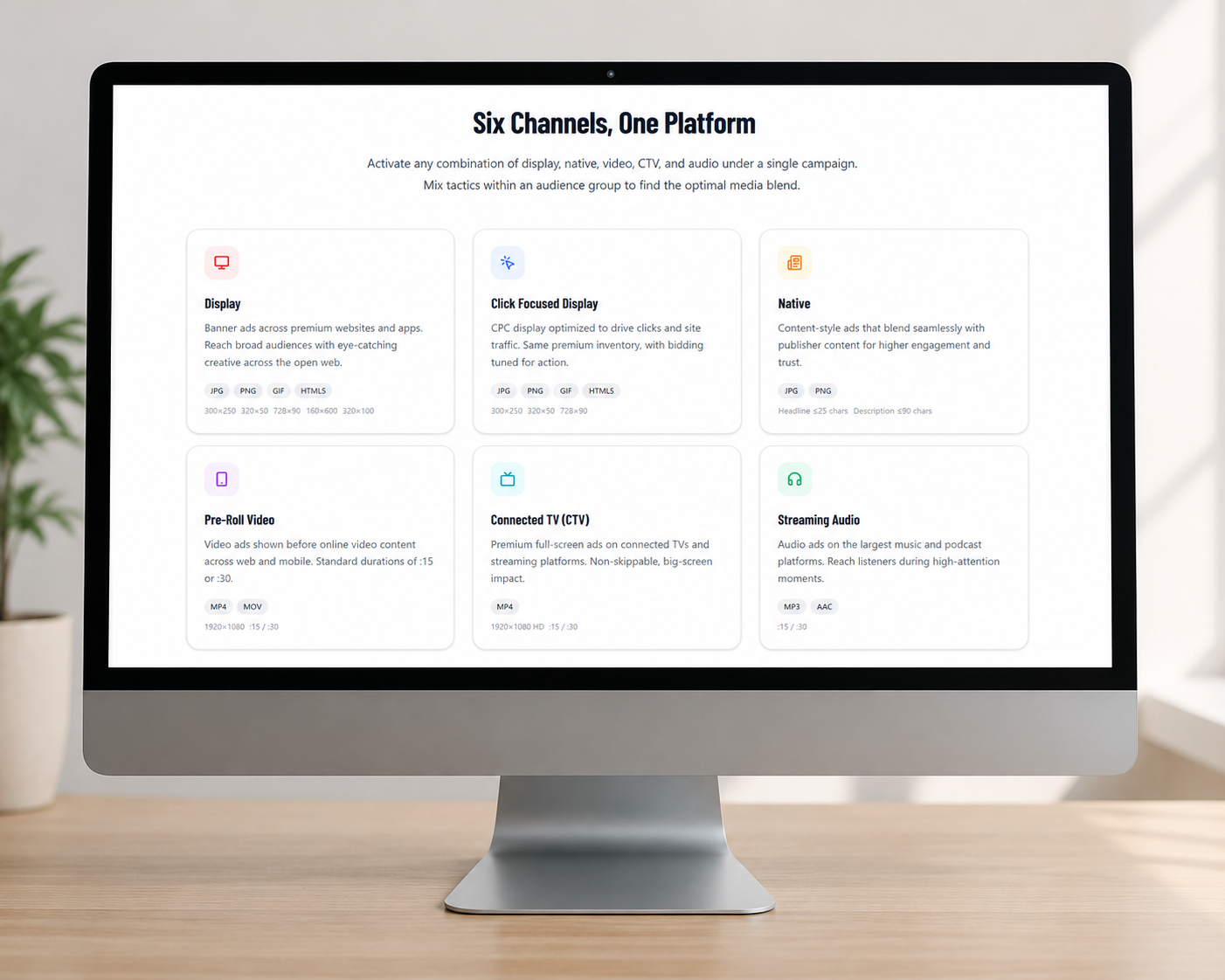
Inside Manifold. The wizard's creative step breaks campaigns into per-tactic upload sections — display, native, pre-roll video, CTV, streaming audio — each surfaced with the exact spec requirements for that channel. Native ad sets accept multiple headlines, descriptions, images, and CTAs so a single tactic can run with several creative variants. HTML5 banners are supported alongside standard image and video formats. Brand logos are auto-extracted from the landing page on Step 1 and reused across every tactic, and any team without internal creative capacity can request on-demand creative help directly from the same screen. Authors can also override the landing page URL on a per-tactic basis, so a single campaign can route CTV viewers to one destination and search clicks to another.
4. Inventory Quality Matters More Than Ever#
Access to inventory is no longer enough. Inventory quality, transparency, and efficiency have become equally important.
As the programmatic ecosystem has grown more complex, marketers have become increasingly focused on understanding where their ads appear, how impressions are sourced, and whether media investments are reaching premium environments.
When evaluating inventory access, consider the following questions:
- What percentage of inventory is sourced directly from publishers?
- Which premium publishers are available through direct relationships versus marketplace transactions?
- How transparent is the supply chain?
- What fraud prevention and quality controls are in place?
Direct publisher relationships often provide advantages in areas such as:
- Inventory quality
- Pricing transparency
- Audience accuracy
- Measurement consistency
- Campaign performance
This is particularly important in Connected TV, where premium inventory remains highly sought after and access varies significantly across platforms.
The strongest DSPs maintain broad integrations with major streaming publishers while also providing flexibility through private marketplaces and curated inventory packages.
Inside Manifold. A single campaign brief can route across the supply relationships held by Yahoo DSP, Google Ads, Meta, TikTok, Spotify, Reddit, and Campaign Manager 360 — so the inventory mix is determined by the campaign's audience and tactics rather than by which DSP happens to be in the contract. Tactic-level pricing (CPM for display, native, video, CTV, and streaming audio; CPC for click-display) is set against published minimum spends, and added-value bonus impressions kick in automatically once a campaign clears certain budget thresholds. The orchestration layer makes the breadth of supply usable from a single workflow rather than from six separate platform logins.
5. Optimization Should Be Continuous#
Most platforms claim to offer AI-powered optimization. The more important question is how those optimizations actually improve performance.
Effective optimization combines automation with meaningful performance signals and transparent reporting.
Some of the most valuable capabilities include:
Real-Time Bid Optimization#
Advanced bidding systems evaluate vast amounts of data to determine the value of individual impressions before bidding.
These systems can adjust bids based on factors such as:
- Audience quality
- Historical conversion likelihood
- Device type
- Geography
- Time of day
- Inventory source
- Creative performance
Comparative Performance Analysis#
Strong platforms make it easy to compare performance across:
- Audience segments
- Creative variations
- Inventory sources
- Geographic markets
- Dayparts
- Devices
This visibility allows teams to make adjustments during campaigns rather than waiting until reporting is complete.
Actionable Pacing and Performance Alerts#
The best optimization tools do more than identify delivery issues.
They help explain why performance is changing and provide recommendations that improve efficiency, whether that's reallocating budget, adjusting bids, updating creative, or shifting inventory sources.
Optimization works best when platforms have access to accurate conversion data and meaningful business outcomes. The more clearly advertisers define success, the more effectively automated systems can pursue it.
Inside Manifold. The wizard ships goal-fit ranking out of the box — tactics are auto-sorted by how well each fits the campaign's primary goal (clicks, awareness, or conversions), with secondary goals breaking ties. Daypart scheduling, frequency caps (hour / day / week / month / lifetime), and device targeting are configurable per tactic. Before submission, an AI strategy-finalize pass refines the campaign's strategy summary and tactic rationale so the operating team and the brand are aligned on what each tactic is doing and why. Once campaigns go live, daily syncs pull metrics from every connected DSP into a unified dashboard, with comparison views across markets, creatives, devices, and dayparts available without leaving the workflow.
6. Measurement Must Extend Beyond Clicks#
As consumer behavior becomes increasingly fragmented across devices and channels, measurement has become one of the most important considerations in media planning.
Relying solely on clicks or last-touch attribution provides an incomplete view of performance, especially for channels such as Connected TV, streaming audio, and digital out-of-home.
Modern measurement frameworks should include several key components.
Identity Resolution#
Identity resolution helps connect exposures, engagements, and conversions across devices and environments while reducing dependence on third-party cookies.
This creates a more complete view of customer journeys and campaign influence.
Sales and Conversion Attribution#
Advertisers increasingly expect visibility into both online and offline outcomes.
This may include:
- Ecommerce purchases
- Lead generation
- Store visits
- Appointment bookings
- Subscription signups
- In-store transactions
Near real-time attribution allows marketers to evaluate performance while campaigns are still active.
Deduplicated Reach and Frequency#
Consumers regularly engage across multiple screens and devices.
Without deduplicated reporting, advertisers often overestimate audience reach and underestimate frequency exposure.
Unified measurement helps ensure campaigns maintain efficient exposure levels while maximizing incremental reach.
Independent Measurement Validation#
Third-party measurement providers add an additional layer of accountability and insight.
Common measurement solutions include:
- Brand lift studies
- Foot traffic attribution
- Incremental sales measurement
- Creative effectiveness testing
- Audience verification
Using independent validation helps advertisers evaluate performance from multiple perspectives rather than relying solely on platform-reported metrics.
Inside Manifold. Measurement is intentionally separated from the platforms that buy the media. Every connected DSP, plus Google Analytics 4, plus any CRM-driven conversion or attendance data the brand can share, feeds into a single Manifold dashboard. From there, teams can see weekly cost-per-transaction and cost-per-visitor against named goals, attendance and visitor analytics for venue brands, drill down by tactic or geography, and export a shareable client link so brands and agencies review the same numbers without juggling logins. Scope-of-Work PDFs at submission lock in deliverables and rates against the original plan, giving everyone an audit trail when the post-campaign report lands.
Why the Operating Layer Matters#
One reality often overlooked in programmatic advertising is that technology alone rarely determines success.
Most teams don't want to spend their day navigating multiple platforms, reconciling invoices, exporting reports, managing creative approvals, and coordinating audience activation across channels. Those operational responsibilities can quickly become as complex as campaign execution itself.
This is the gap Manifold was built to close. We sit above the DSPs — Yahoo DSP, Google Ads, Meta, TikTok, Spotify, Campaign Manager 360, and others — and turn the six pillars above into a single workflow:
- A five-step campaign wizard that produces a complete brief, audience, tactic mix, creative set, and Scope of Work without the team ever leaving the platform.
- AI-assisted segment, geo, and keyword recommendations that read the brief and the landing page, so planners start with a defensible starting point rather than a blank canvas.
- First-party list onboarding that hashes PII in the browser before upload, keeping compliance teams comfortable.
- Per-tactic pricing, added-value tiers, and added-value impression delivery all calculated from the same rate card the billing system uses, so the budget the brand sees in Step 3 is the budget they see on their invoice.
- Daily syncs from every connected DSP into a unified reporting layer, including weekly cost-per-outcome views, attendance and conversion attribution where available, and shareable client links.
- A submission flow that hands the operating team a fully specified campaign — audiences, tactics, creatives, dates, pacing, frequency caps, tracking config, and a strategy summary — ready to traffic.
The DSPs optimize the impression. Manifold optimizes the process around the impression — which is where most performance shortfalls actually live for in-house teams and agencies running across more than one platform.
A Quick Self-Assessment#
If you're evaluating your current programmatic stack, consider the following questions:
- Can you estimate cross-channel audience overlap before launching a campaign?
- Are you leveraging standard, custom, and predictive audiences?
- How many creative variations are actively being tested within a typical campaign?
- Do you understand how much of your spend reaches premium, direct publisher inventory?
- Can you measure outcomes beyond clicks, including sales, leads, visits, or brand lift?
- Is reach and frequency reporting unified across channels and devices?
- Does the planning team and the billing team see the same rate card?
If the answer to several of these is "not really," the gap is usually in the operating layer above the DSPs rather than the DSPs themselves — and that's the layer worth investing in first, because everything downstream of it (budget allocation, creative strategy, performance reporting) inherits the same constraints.
Programmatic advertising continues to evolve quickly. The platforms and partners that succeed will be those that make planning easier, targeting smarter, creative more effective, measurement more reliable, and campaign execution more efficient.
The technology matters. The strategy matters. Increasingly, the operational layer connecting everything together matters just as much.
If you'd like to see how the Manifold campaign workflow turns these six pillars into a single working surface, the team can walk through it with your audience and goals.